Exploring Climate Change Adaptation in Kajiado: A Journey Through Haraf Farm, Osiligi Dairy Farm, and Senior Chief Rissa Secondary School
As part of our WakiliPicha Climate Action initiative, a few days ago, I stepped onto the scorched earth of Kajiado. Amid the sweltering heat, I couldn't help but feel a profound sense of despair. Most of the land was barren and dry, a stark reminder of the devastating impact of the climate-change-induced drought. I had set out to explore the innovative ways in which Kajiado residents were adapting to these harsh conditions. My mission was clear: to find climate change adaptation projects in the area and later document the inspiring stories of those who had managed to turn the tide against this global crisis. The ultimate goal is to stimulate more action towards climate change adaptation, resilience, and mitigation.
I had the pleasure of meeting Mavado, a relatively young bodaboda rider who served as my guide while touring the area. Born, raised, and educated in Kajiado, he demonstrated an impressive knowledge of the region and proved to be a reliable companion throughout my travels. His passion for his community and willingness to share his insights left a lasting impression on me and highlighted the valuable contributions that local residents can make toward promoting sustainable development. Mavado provided me with intriguing knowledge regarding the local community and their implementation of farming techniques specifically tailored for the drought-stricken area. With his assistance, I was able to visit and explore three locations: Haraf Farm, Osiligi Dairy Farm, and Senior Chief Rissa Secondary School.
HARAF FARM
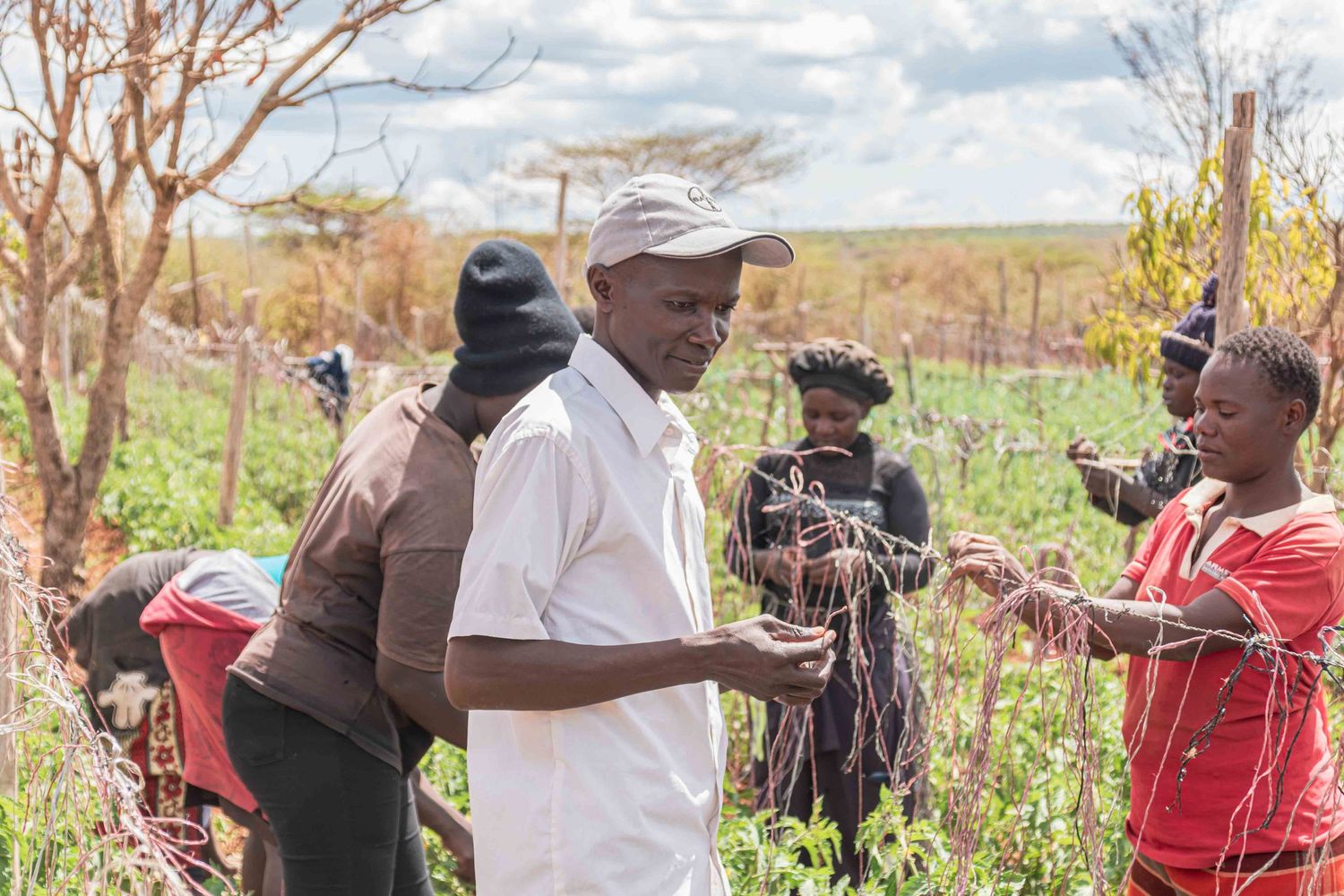
Haraf Farm is a verdant expanse that cultivates a variety of crops including cabbages, tomatoes, and onions. In addition to their thriving produce, the farm also practices agroforestry, with rows of towering mango trees promoting sustainable land use practices. The farm plays a crucial role in ensuring food security for the people of Kajiado, and its produce is distributed in some parts of Nairobi, making it a significant contributor to the region's food supply chain. At the farm, we met with Ezekiah, the farm manager, who gave us an in-depth explanation of their drought-adapted farming practices.
Being a semi-arid region with limited and unreliable rainfall, irrigation is critical for crop farming in Kajiado. Haraf farm uses a borehole and storage tanks to access and conserve water for their crops. The farm depends on drip irrigation, which requires professional plumbers to set up and maintain. Although the recommended best practice is to irrigate twice a day, in the morning and evening, Haraf farm sometimes has to irrigate during midday due to the drought. The drought has also led to an increase in pests on the farm, which has affected their tomato yields. Fertilizers, particularly nitrogenous fertilizers, scorch the tomatoes because of the lack of sufficient water during top-dressing. Despite these challenges, the farm can harvest 10 tonnes of tomatoes a week, which sell for about Ksh 50,000 per tonne, resulting in a potential revenue of Ksh 2 million in a month during the harvest period. The farm also harvested about 5 lorries of mangoes in the last season.
Ezekiah's observation regarding the benefits of water harvesting in Kajiado is quite significant. According to him, water harvesting techniques, such as the construction of dams and water tanks, would provide a reliable source of water for the residents. Additionally, harvesting water would promote agricultural productivity in the area, improving food security, and diversification of livelihoods for the local Maasai communities. However, this is subject to the locals' willingness to explore different means of livelihood apart from pastoralism.
Ezekiah underscored the significance of conducting soil testing before commencing any agricultural projects in Kajiado. Regrettably, soil testing is frequently disregarded due to the high costs involved. This is concerning since it is vital to verify that the soil is suitable for crops and, ultimately, to attain a fruitful harvest. He emphasized that affordable access to soil testing facilities must be made available to farmers by policymakers and agricultural organizations. Additionally, access to high-quality seeds is also critical for the success of climate change adaptation in agriculture. Unfortunately, there is a pre-eminent problem of unscrupulous seed sellers who offer low-quality or untested seeds that seriously impact crop farming success in Kajiado.
Upon inquiry, I was informed about a positive shift towards education in the Maasai community with Maasai parents in Kajiado embracing sending their children to school. Education can provide young people with the knowledge and skills needed to understand the impacts of climate change on their environment and communities, as well as how to develop and implement effective adaptation strategies. As educated Maasai youth return to their communities, they can use their knowledge and skills to advocate for and implement sustainable practices, such as water conservation, soil conservation, tree planting, and sustainable agriculture. I confirmed this by talking to the deputy Principal Mrs. Mokaya at a nearby school named Senior Chief Rissa Secondary. It became apparent that empowerment through education can ultimately contribute to the diversification of the Kajiado residents’ livelihood in the long run.
OSILIGI DAIRY FARM
Mavado's guided tour took me to a nearby dairy farm that is defying climate change odds with its modern approach to dairy farming. Unlike the Maasai's traditional pastoralism, Osiligi Dairy Farm, a 50-acre farm, uses innovative techniques to adapt to the harsh effects of drought in Kajiado. The farm's ability to cultivate various fodder crops that are resistant to erratic rainfall patterns and water scarcity is impressive. Even during the dry season, they employ irrigation using water from their boreholes, a remarkable adaptive strategy to the prolonged drought.
Osiligi Farm also breeds Dorper sheep to boost their population and sell them as a source of meat. Raising Dorper sheep is a profitable business opportunity that can yield high returns when coupled with effective animal care techniques. Compared to other sheep breeds, Dorpers mature quickly, which can translate to a quicker return on investment. Additionally, they are well-suited to diverse weather conditions and have robust immune systems, making them more resistant to common illnesses and pests.
The farm's self-sufficiency extends to their production of dairy meal as well as their production of silage. More impressively, the farm's model is inspiring other farmers in the region to adopt hybrid animals and zero-grazing, a proven method that improves yields and better suits the current climate conditions. Notably, Osiligi Dairy Farm has provided employment opportunities for a good number of young people in the area.
SENIOR CHIEF RISSA SECONDARY SCHOOL
As the day drew to a close, I was led to Senior Chief Rissa Secondary School, a Public, Sub County level, Mixed Boarding/Day Secondary School a few kilometers from the Osiligi Farm. As I made my way through the corridors, the sight of some struggling and dying trees caught my attention. Upon meeting with the Deputy Principal, Mrs. Zipporah Mokaya, I expressed my interest in collaborating with the school to enhance its environmental conservation efforts, including educating students about climate change adaptation and resilience.
I was pleased to learn that the school has a well-established environmental club and a tree-planting policy in place. Under this policy, each student is required to care for a tree throughout their four-year stay at the school. Mrs. Mokaya shared the school's dedication to inspiring students to become advocates for tree planting in their communities. According to her, the drought has severely affected the trees within the school. However, she went on to show me some pictures from a recent tree-planting event organized by the school a few weeks earlier, which left a profound impression on me. Her enthusiasm was truly inspiring. I shared with her my plans for a greening campaign in Kajiado schools and explained how I intend to introduce a climate action sub-club as an extension of their environmental club. This sub-club will concentrate on educating students about climate change adaptation, resilience, and mitigation while also teaching them photography skills for climate action, which they can use for income-generating activities in the future.
Our conversation was incredibly fulfilling, and I left with a sense of satisfaction about the day's accomplishments. I am optimistic about the potential of this project to contribute to the school's climate change awareness efforts, as well as to equip students with practical skills that they can utilize in their future endeavors and benefit their communities. It is exciting to envision a future where these young minds are empowered to lead the way towards a more sustainable future.
WHAT IS THE TAKEAWAY?
As the world faces the pressing challenge of climate change, the need for urgent action has never been more evident. The reality of the situation is daunting, as we witness the devastating effects of droughts in our daily lives. But in the midst of this crisis, we must remember that hope is not lost. The stories of farmers like Haraf Farm and Osiligi Dairy Farm are inspiring examples of how innovative climate change adaptation projects can be developed and implemented. As communities invest in educating their children, schools like Snr. Chief Rissa become beacons of hope and opportunity, providing a platform to inspire young people to action through targeted climate change awareness efforts for long-term, sustainable impact. By working together and embracing innovative climate change adaptation, resilience, and mitigation projects, we have the power to shift the course of history and pave the way for a sustainable future.
The author is a Technology & Climate Change Lawyer. He is the founder of the WakiliPicha Climate Action.